

METHOD V
From experience to evidence-informed policy choices
Method V shows how personal experiences are carefully collected, analysed and translated into insights and policy choices. Policy choices are not necessarily the endpoint: repeat measurement makes it possible to compare developments and adjust where needed.
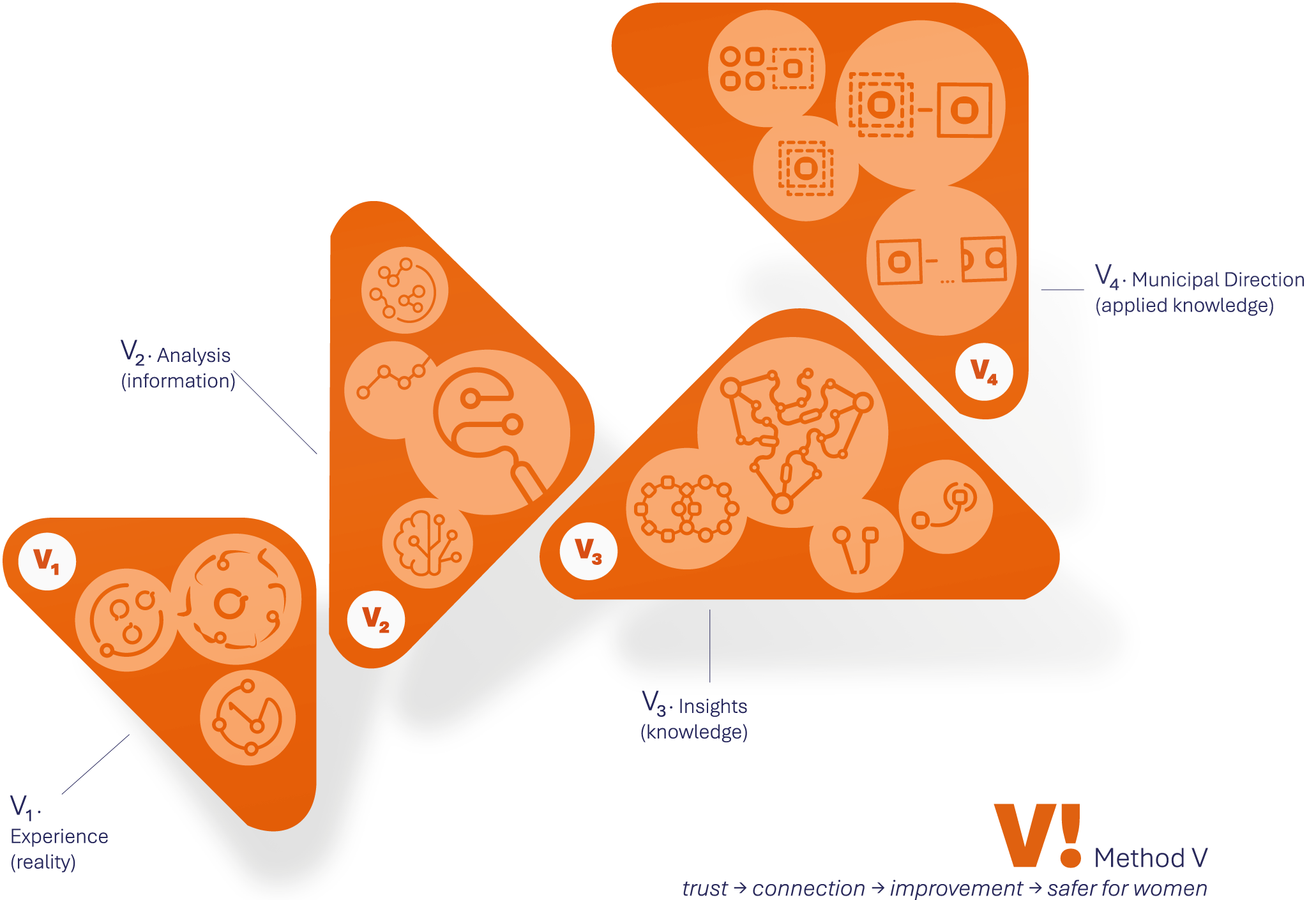
After implementation, measurement can be repeated: compare, monitor, adjust — back to V₁.
THE METHOD
Four phases, one recurring cycle
Individual experiences are not treated as isolated signals. By structuring, comparing and interpreting signals, Method V makes recurring patterns visible and creates a careful basis for policy choices. After implementation or over time, measurement can be repeated and the cycle starts again.
V₁ – EXPERIENCE
Collecting experiences carefully
Vrouwveiliger collects location-based signals about where, when and in what context women feel unsafe in public space. Respondents can easily share their experience and indicate which circumstances played a role.
Time · Surroundings · Context
Concrete outcome
A structured collection of location-based signals about perceived safety, linked to the time, surroundings and context in which the experience occurred.
V₂ – ANALYSIS
From individual signals to recognisable patterns
The collected signals are organised, compared and examined for recurring similarities and differences. AI can support recognition, organisation and interpretation of patterns. Analysis and interpretation remain under Vrouwveiliger’s substantive responsibility.
Clustering · Patterns · AI interpretation · Analysis
Concrete outcome
Organised and analysed information showing patterns by location, time, circumstances and perceived safety.

V₃ – INSIGHTS
Giving meaning to what becomes visible
The identified patterns are interpreted substantively. Signals are connected, differences distinguished and relevant nuances made visible. This creates a better understanding of what lies behind the research results.
Meaning · Connecting · Distinction · Nuance
Concrete outcome
Evidence-informed insights into which locations, times and circumstances warrant attention and which differences between areas, groups or situations may be relevant.

V₄ – POLICY CHOICES
From insights to considered next steps
The insights are translated into possible policy directions and next steps. Municipalities can determine priorities, identify where collaboration is needed and decide which choices are appropriate and feasible. After implementation, V₁ can be started again with a repeat measurement.
Prioritising · Collaborating · Deciding · Implementing
Concrete outcome
A sound basis for policy choices and next steps, together with a clear starting point for later comparison, monitoring and adjustment.
REPEAT MEASUREMENT
After V₄, the cycle can begin again
Method V does not end with policy choices. After implementation or after a defined period, perceived safety can be measured again. New signals then move through the same four phases, making comparison and adjustment possible.
After implementation, measurement can be repeated: compare, monitor, adjust — back to V₁.
A repeat measurement does not prove on its own that a specific intervention caused a change. It does make developments in perceived safety visible and provides a stronger basis for evaluation and further research.
Privacy and responsible data processing

No account or contact details
You do not need to create an account or provide your name, email address or phone number. We do not use tracking cookies.

Only necessary data
We only process information that is necessary for the research.

Non-identifiable results
Analyses and reports cannot be traced back to individual respondents.

Secure and restricted access
Data is stored securely and is accessible only to authorised users.